Well I
didn’t expect it, but my first personal experience with death here has been the passing of my kitten, Boo. I had kept her inside my house to be on the safe side but it was to no avail. She had been getting thinner and thinner for a few weeks and while I was a little concerned I
didn’t think it was anything too serious. Then she became really lethargic, and on her last day she ate an unusually large amount; she had hardly been touching her food before that. That night she began crying and twitching and I knew right away that this was it. It was very sad to watch because I
couldn’t do anything for her besides give her my bed and talk to her. I slept on the floor (where the ants live!) since she was biting and clawing me, kind of dangerous since I
didn’t actually know what was wrong with her. In the morning I found her in the backyard, long gone. I collected a shovel from my neighbor
Esa who was really concerned that I was standing in the middle of his compound asking for tools while crying but he dutifully handed one over after I had drawn a picture of it on the ground so he would know what in the world I was talking about. (They call a shovel a ‘pail’ here which is very confusing since you feel like you’re asking for a bucket when you actually want an instrument with which to dig.) One of my best friends here, a twelve year old named
Makalo, ran into me on the way home and immediately wanted to come over and help me, which is why he’s one of my best friends here. He collected a couple of the other boys that study at my house, and along with a couple of my sisters, and my brother’s wife and baby, we dug a grave in my postage stamp sized back yard and buried little Boo. Everyone was very solemn and it was a nice way to put our kitten to rest. And then came…’How Gambians Deal With Grief’:
1. ‘Stop Crying!’ :
Lol, I thought they just said this to little kids and to babies, but no, apparently when you are bereaved you also get this command barked at you. We’re not big on ‘expressing our emotions’ in The Gambia unless those emotions happen to be gaiety or frustration. Screaming with laughter and fighting in public are both pretty common but shed a few tears because you’re sad and you get a lot of nervous looks. Now I already knew that you
aren’t supposed to cry when a) the doctor is aggressively scrubbing your open wound in order to dress it b) You slam your finger in car door c) your brother beats you with a branch he pulled off of a tree d) you are a fussy baby, but I thought I’d get a pass for a dead kitten. Um, no. The kids put up with tears streaming down my face for about twenty minutes and after that they would demand that I stop crying because it would ‘make me sick’. The bottom line? There’s no crying in Africa. We’
ve got big problems and your weeping
isn’t helping.
2. ‘Here’s a better one.’ Now this
isn’t unique to Africans but it definitely falls into their cultural behavior so I’m including it. About ten minutes after
Esa had given me the shovel he showed up at my door saying, ‘I’
ve got a better one, go with
Lamin (his five year old son)’. Of course I assumed he was referring to a better ‘pail’, but no, when I got there I was promptly handed a tiny, tiny kitten whose head was about twice the size of its body. Well I was still crying and this kid was holding this kitten and my nice African neighbors were a little unnerved by the American falling apart over a pet, so I took it. I
didn’t want another kitten but at that moment I
wasn’t in any position to say so. I took the kitten and went back home, ready to start digging, so I set her in a pile of laundry to be dealt with later. Well that was a week ago and as I type this ‘
Butut (the smallest denomination of Gambian currency) is (hopefully) being bottle fed by my little sister
Kaddy while I am in
Kombo. I say it’s not unique to Africans because I’m sure all the pet owners amongst you are familiar with the ‘Your pet died? I’m so sorry. What are you going to get next?’ conversation. What is unique to Africans is that they do this with children as well, or ‘instead of’ I suppose since they don’t generally have pets. If a woman’s child dies she is usually given another child belonging to a sister, aunt, close friend, etc. I don’t think it happens right away but it definitely happens within a fairly short period of time. And while my reflex is to say, ‘No, I don’t want another kitten (child), the reality is that if you are preoccupied trying to feed and care for this new little bundle of joy you are spending a lot less time holed up in the back of your house crying on your bed.
3. They have a
week long funeral. Okay, maybe not for a kitten, but for the passing of a person pack your bags, you’re going to be spending a significant amount of time praying away from home. Boo passed away two days after the chief’s daughter, my mother’s niece, died in a nearby village. It was a very sad event. She was only thirty three with a seven year old child. She worked at the hospital and had apparently had some health issues. One morning she collapsed in her compound when everyone was out and died later that day in the hospital. People traveled from far and wide to extend their condolences and my mother was gone well over a week for the funeral. I
wasn’t there and I have yet to attend one of the funerals held in the village so I don’t know the details but there seems to be a lot of
Quoran reading going on. I don’t know what’s keeping me from attending. It’s the same thing that keeps me away from the mosque. It feels intrusive somehow, like it’s a step over the line of what is okay for me to be included in as a guest and what is too personal for an outsider. This of course is dumb and I am repeatedly invited to go to the latter, the mosque, yet interestingly not the former, funerals, which seems like the more accessible between the two, but I still feel a little uneasy. I’ll go when it’s more personal and not much of a choice anymore I suppose.
Okay, so that’s the ‘death’ portion of this entry. I was going to do ‘life’ next but honestly I’m getting a little sleepy and a lot sloppy so I’m going to go with the bulleted list instead.
School corner: We’re in the third, which is the last, term of the school year. The 9th grade students are studying for their national exams and I’m helping them by making board games that give them an opportunity to read questions the way they will be written on the exam and to review their factual knowledge. They love them and are always asking me when we can play. I’m still working with the younger kids on phonics and reading skills. It astounds me how engaged they remain when they struggle so much with basic literacy. Good for them. I would have given up a long time ago which is evident in the amount of Mandinka I am able to speak, or not speak, as the case may be.
Health corner: As I type this I have NO infections of any kind! Clap for me! (That’s what we say when a kid answers a question correctly at school.) I’ve actually been lucky in terms of my health. I have almost constant skin infections, some small, some not so small, but I’ve never been ‘sick’ which is pretty impressive considering the ‘food/water/environment/developing country’ situation. Hopefully this will remain a true statement for the next year and a half.
Movie situation: So I was pretty sure that when I got back home I would be cloistered in my house for at least two months catching up on all the movies I missed while I was gone. Not necessarily so! They sell these DVDs in Kombo that have up to fifteen movies of varying quality on a disc. Sure, sometimes you have to put up with a thumb in the corner of the screen but it’s worth it if I can take a break from being ‘culturally appropriate’ and sit on a couch drinking Cokes and watching ‘Precious’ in the Peace Corps transit house on a Sunday afternoon. Yay for breaking copyright laws!


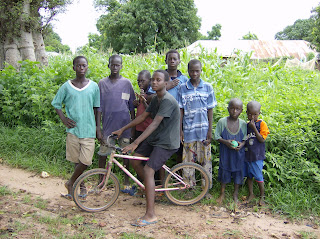 Boys in Jappineh
.jpg)

 Charlie at Home (
 Charlie Taking a Nap Next to
  Charlie and
.jpg) A typical
A typical 
 e to start tuning an unbelievably scratchy shortwave radio a stone’s throw (more of a toss really) away. I like these people a lot and I know it’s unintentional. They just have no concept of what it means to sit down and enjoy a book. I’
.jpg)
 Boo (chewing my cell phone charger)
.jpg) Me with
Me with 
.jpg)
.jpg)
.jpg) A village cow
A village cow .jpg)
